
In the stockyards of ports, power plants, and steel mills, there’s always a “giant” quietly busy at work—it can pile tens of thousands of tons of bulk materials into neat “hills” and also precisely reclaim materials for transport. Without it, the entire material handling process would grind to a halt. As a professional with 10 years of experience in the bulk material handling field, I’m often asked: what exactly is this giant machine?
Simply put, a stacker reclaimer is a dedicated “material steward” for bulk materials. It’s a large continuous loading and unloading machine capable of both “stacking” (stockpiling materials) and “reclaiming” (retrieving materials from the stockpile). Its primary role is in bulk material storage scenarios. Its core value lies in achieving efficient material turnover and precise control, making it an indispensable piece of equipment in modern stockyards.
Don’t think it’s far removed from our daily lives; the coal used for your household electricity and the sand and gravel for building houses have most likely passed through its “hands.” Today, I’ll use plain language to help you get to know this “giant” from the ground up.
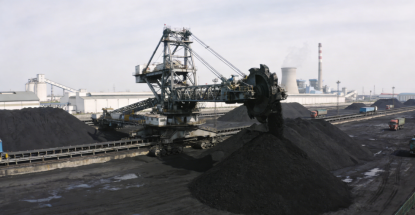
Let’s start with its “origins”—the stacker reclaimer evolved from the bucket wheel excavator. As early as the 1960s, China began designing small stacker reclaimers. The models back then were simple and efficiency was not high.
Now, it has evolved into an “all-rounder,” with maximum production capacity reaching over 10,000 tons per hour, equivalent to the total capacity of 100 heavy trucks. As a witness to its evolution, I’ve seen it upgrade from “manual operation” to “intelligent unattended operation,” fundamentally changing the pattern of bulk material handling.
Many people confuse stacker reclaimers with ordinary cranes, but there are significant differences. Cranes focus on “lifting and transporting,” while stacker reclaimers focus on “stockpiling + reclaiming,” operating continuously without interruption.
To use an analogy, a crane is like a “courier,” taking a break after each delivery; a stacker reclaimer is like a “production line worker,” working non-stop from morning to night. Even in a stockyard handling tens of thousands of tons, it can complete stacking and reclaiming tasks according to schedule—this is its core advantage.
What Are the Different Types of Stacker Reclaimers? Understanding the Common Types at a Glance
As an industry professional, I often say that stacker reclaimers must be “tailored to the application”—different stockyards and different materials require different models. Currently, the three most common types each have their own “specialties.”
The first is the bucket wheel stacker reclaimer, which is also the most commonly used type. Its front end has a wheel fitted with “buckets,” called the bucket wheel—this is its “reclaiming hand.” At the back, there’s a luffing and slewing boom that moves flexibly like a human arm.
It is suitable for small to medium-sized stockyards, such as those in small and medium-sized power plants and cement plants. It can both stack and reclaim, offering good value by combining two functions in one machine. In 2025, over 60% of stacker reclaimers purchased by domestic power plants were of this type.
The second type is the bridge-type bucket wheel stacker reclaimer. It looks like a large “portal,” with its gantry straddling the rails, enabling large-span operation. Its movable beam can raise and lower, and the bucket wheel is mounted on a trolley that moves laterally, giving it a wider reclaiming range.
This type is suitable for large ports and massive power plant stockyards. For instance, the coal yard at Qinhuangdao Port often uses this type to handle tens of thousands of tons of bulk cargo. Its stacking height can reach 15–20 meters—as tall as a five-story building—maximizing space utilization.
The third type is the circular stockyard stacker reclaimer, designed specifically for circular stockyards. It has two independent systems, allowing stacking and reclaiming to occur simultaneously without interference, maximizing efficiency.
I once witnessed its operation at a large steel plant. The stacker rotated around the central column to distribute material, while the reclaimer simultaneously retrieved material—the entire process was seamless. It’s especially suitable for applications with high material blending requirements, such as in the sintering yards of steel plants.
What Are the “Internal Organs” of a Stacker Reclaimer? A Breakdown of Core Structures
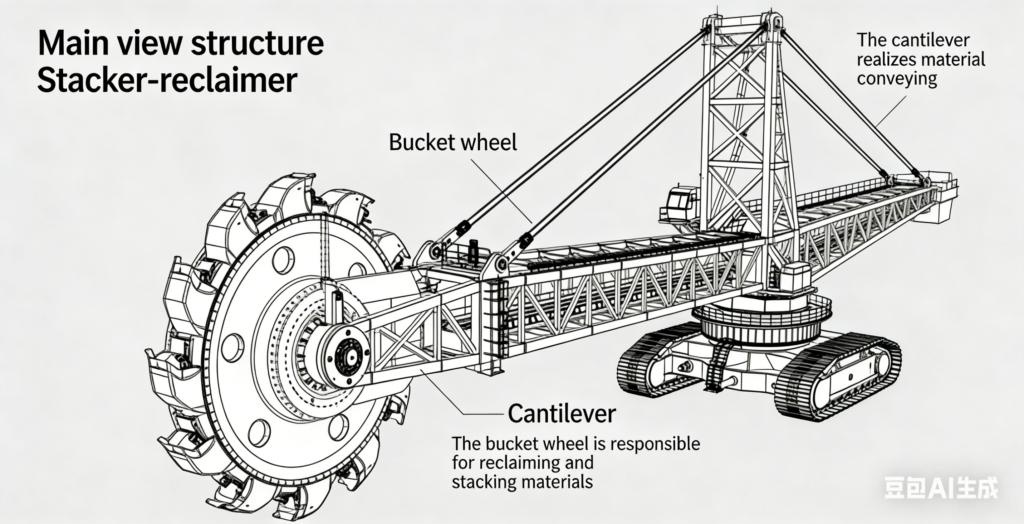
Although stacker reclaimers appear massive, their internal structure is quite sophisticated. Every component has a specific role, and none can be omitted. As someone who frequently works with them, let me break down a few core components so you can understand them at a glance.
First is the bucket wheel mechanism—the “core” of reclaiming. The buckets on the bucket wheel come in three types: rimless, semi-rimmed, and rimmed. Among these, the rimless type is the most common, as it can handle stickier materials and has faster discharge rates.
With new technologies in 2025, the bucket wheel now uses wear-resistant composite materials, extending its service life by 40% compared to 2023, significantly reducing maintenance costs.
Next is the slewing mechanism, which acts as its “rotating joint.” It allows the boom to rotate 360 degrees, enabling the stacker reclaimer to cover the entire stockyard. Slewing speed can be adjusted steplessly between 0.01 and 0.2 revolutions per minute for precise control of the working range.
On modern intelligent models, the slewing mechanism is paired with laser scanning positioning, achieving error control within ±3 cm, eliminating worries about inaccurate reclaiming or crooked stacking.
Then there’s the traveling mechanism, its “legs and feet.” Most designs use rails, allowing the stacker reclaimer to move longitudinally along the tracks, expanding its working range. In 2025, the adoption rate of permanent magnet synchronous motors in traveling mechanisms reached 58%, reducing energy consumption by 18%.
In addition, the boom belt conveyor is responsible for material transport; the tail car connects to the stockyard’s main conveyor belt; and the luffing mechanism controls the raising and lowering of the boom. These components work together to ensure the stable operation of the stacker reclaimer.
Where Are Stacker Reclaimers Used? These Scenarios Depend on Them
Many people think stacker reclaimers are only used in ports, but that’s not the case. Wherever bulk materials need to be stored and handled, stacker reclaimers are at work. Based on my experience, let me share their main application scenarios.
The most prominent scenario is power plants, especially coal-fired power plants. Power plants require massive coal storage. The stacker reclaimer is responsible for stacking incoming coal into piles and then precisely reclaiming it according to the boiler’s demand, ensuring stable power generation. In 2025, sales of stacker reclaimers to domestic power plants reached 3,200 units, a 8.7% increase quarter-over-quarter.
Next are ports and terminals. These are hubs for bulk cargo import and export. Materials like iron ore, coal, and sand and gravel need to be quickly stockpiled and transshipped. Efficient stacker reclaimer operation significantly boosts port throughput. In 2025, China’s export value of stacker reclaimers increased by 11.3% year-over-year, mainly sold to Southeast Asia and the Middle East.
Beyond these, steel plants, cement plants, and mines also rely heavily on them. Steel plants use them to handle iron ore and coke; cement plants process limestone and gypsum; mines use them for stockpiling and handling raw ore. It’s like a “material steward” for these industries, quietly supporting their production operations.
Top 6 Frequently Asked Questions About Stacker Reclaimers
Over the years in this industry, I’ve been asked countless questions about stacker reclaimers. Here are the six most common ones, which I’ll answer today to help clear up any confusion.
- How efficient are stacker reclaimers?
Mainstream models currently have reclaiming capacities ranging from 300 to 6,000 tons per hour. Large bridge-type models can reach up to 10,000 tons per hour—over 100 times more efficient than manual handling. - How many operators does it need?
Early models required 2–3 people to operate collaboratively. Today, intelligent models enable unattended operation, allowing one person to remotely monitor multiple machines, significantly reducing labor costs. - Is maintenance complicated?
Core components like the bucket wheel and slewing mechanism require regular lubrication and inspection. Routine maintenance is typically performed every 3–6 months. With proper maintenance, equipment lifespan can reach 15–20 years. - What materials can it handle?
It can handle almost all bulk materials, such as coal, iron ore, sand and gravel, coke, gypsum, etc. By adjusting the bucket wheel and conveyor belt parameters, it can adapt to the characteristics of different materials. - What are the advantages of intelligent stacker reclaimers?
Intelligent models are equipped with digital twin systems and predictive maintenance features, which can reduce unplanned downtime by up to 26%. They also precisely control material blending uniformity, improving production quality. - How big is the gap between domestic and imported stacker reclaimers?
Domestic models are now very mature, with the localization rate for key components reaching 73%. They offer advantages in cost-effectiveness and after-sales service compared to imported models, occupying a dominant position in the domestic market.
New Type Intelligent Stacker Reclaimer
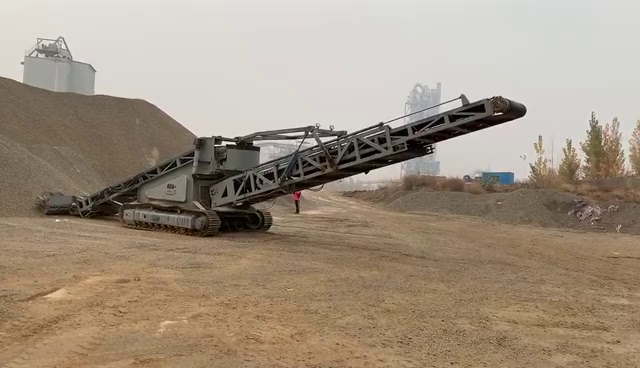
Our company has developed a new type of intelligent stacker reclaimer with a design conveying capacity of up to 1,000 tons per hour. For a client in Inner Mongolia, the equipment designed for a rated capacity of 1,000 tons/h has actually achieved a peak efficiency of 1,480 tons/h in practical use.
This equipment offers the following advantages:
- High production efficiency, conservatively estimated at 1,000 cubic meters per hour.
- Time-saving: uses the traveling mechanism and the slewing/luffing mechanisms for reclaiming and stacking to change the stacking and discharge points.
- Uniform feeding with stable operating speed. The difference between maximum load and average load during operation is minimal, resulting in low power consumption variation, energy efficiency, and low operating costs.
- Simple operation: easy to use with minimal training, safe and reliable, capable of automation, reducing labor intensity.
- Low investment: no need for specialized equipment foundations at the site, resulting in significant overall cost savings.
More information of this equipment please check this article: https://cnnewmachine.com/intelligent-stacker-reclaimer-compact-model-setting-new-benchmarks-for-efficiency-and-intelligence-in-the-bulk-material-handling-industry/
Conclusion
A stacker reclaimer is not simply a “large machine”; it is the “material hub” of modern industry. Through its efficient and precise operation, it solves the challenges of bulk material storage and turnover, supporting the development of multiple industries, including power generation, ports, and steel manufacturing.